VetStack
FeaturesPricing
BlogFAQContact
HomeAI for Veterinarians

2026 guide

AI for veterinariansA practical map of what’s useful today, and where to start.

AI is already in the exam room, the lab and on the phones. This guide covers what each kind of tool actually does, how to judge one, the risks worth managing, and a four-week plan to try it without disrupting your clinic.

Try VetStack free Read the guide

Updated November 202610 min readBy the VetStack team

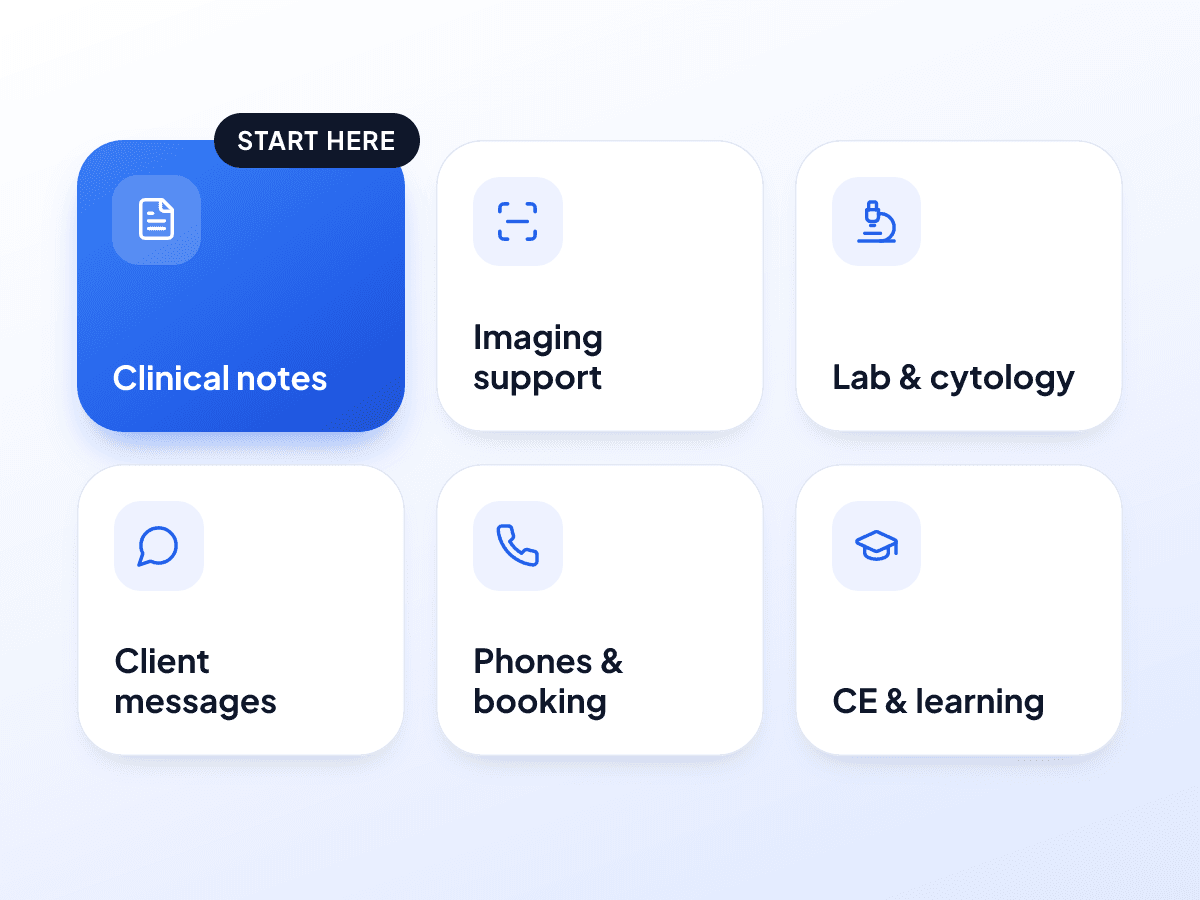
AI for veterinarians: six areas of practice where AI is used, with clinical notes highlighted as the place to start

On this page

  1. The short answer
  2. Six areas AI is used
  3. Time-back estimate
  4. How to judge a tool
  5. Risks to manage
  6. 30-day starting plan
  7. FAQ

Is AI worth it for veterinarians?

The short answer

For most clinics, yes, starting with medical records. AI scribes take the most repetitive writing off the veterinarian’s plate, and the time is easy to measure. Imaging, lab, phone and communication tools can help too. Whatever you choose, the rules are the same: a person reviews everything, client data stays protected, and the veterinarian stays responsible.

The landscape

Six areas where AI is used in veterinary practice

Grouped by where they sit in the clinic’s day. Each one helps with a different bottleneck, and each needs its own checks.
Start here

Clinical documentation

AI scribes record the consult or your dictation and draft the medical record, usually as a SOAP note.

Helps with
Records finished between appointments instead of after hours; more complete histories.
Watch out for
Every draft needs your review. Check that the tool leaves out what wasn’t said rather than guessing.

Compare veterinary AI scribes →

Imaging support

Software that reviews radiographs and flags possible findings, sometimes alongside a teleradiology service.

Helps with
A second set of eyes, and faster triage when no radiologist is on hand.
Watch out for
Treat flags as prompts, not diagnoses. Ask which species, views and findings it was validated on.

Lab and cytology

In-clinic analyzers that use image analysis on blood smears, urine sediment or fecal samples.

Helps with
More consistent counts and fewer manual reads on busy days.
Watch out for
Know when to confirm with a manual review or a reference lab, especially for unusual results.

Client communication

Drafting emails, aftercare instructions, reminders and replies to reviews, often with general tools like ChatGPT.

Helps with
Clearer, kinder messages in less time, at a reading level clients understand.
Watch out for
Keep client identifiers out of general chatbots and check every clinical detail.
ChatGPT for veterinarians →

Phones and front desk

AI receptionists that answer calls, book appointments and handle routine questions out of hours.

Helps with
Fewer missed calls and less hold time when the team is busy.
Watch out for
Make sure urgent and emergency calls reach a person quickly, and test it with your hardest calls.
Virtual receptionists explained →

Learning and CE

Study tools that quiz you, explain concepts and summarize papers, for students, technicians and practicing vets.

Helps with
Faster review and practice questions on demand.
Watch out for
Summaries can drop important caveats. Go back to the source for anything you’ll act on.
Free exam prep →

Try your own numbers

How much time could AI give back on records?

Move the sliders to match your clinic. The estimate uses only what you enter, so it’s as honest as your inputs.

Your estimate

6.8hrs / week

About 311 hours a year across your record-keeping, if an AI draft replaces writing from scratch.

Saved per record
4.5 min
Records per week
90

Built from the numbers you enter, not from a study. Assumes 46 working weeks a year. Time your own records for a few days for the most honest input.

Before you buy

How to evaluate a veterinary AI tool

Eight questions to ask any vendor. A good one will answer all of them in writing without hesitating.
01

Does it train on your data?

Get a clear yes or no in writing for recordings, notes and client details. “Anonymized” needs explaining.

02

Where is data stored, and how?

Encryption in transit and at rest, access limited to your practice, and named sub-processors.

03

Can you review before it counts?

Nothing should reach a record or a client until a person has read it and can edit it.

04

Is it built for your species?

Small animal, equine, exotics and production animals need different terminology and normals.

05

Does it fit your PIMS?

Copy and paste works with any system. A direct integration is better only if it’s reliable.

06

Is the pricing public?

Published prices, a free tier or trial, and no long contract before you’ve tested it with real patients.

07

Can you get your data out?

Export and deletion on request, including after you cancel.

08

Who is accountable?

The veterinarian signs the record. The tool should make that review easy, not encourage skipping it.

Eyes open

The risks of AI in veterinary practice

None of these are reasons to avoid AI. They are reasons to set it up properly, the same way you would with a new anesthetic protocol.

Confident mistakes+

Generative AI can produce fluent text that is wrong. Build the review step into the workflow rather than relying on people to remember it.

Automation bias+

The better a tool usually is, the easier it is to stop checking. Spot-check AI output regularly, especially for new team members.

Consent to record+

Several US states require everyone in a conversation to agree before it is recorded. Tell clients you use an AI scribe and note their consent; a sign in the exam room and a line on your intake form help.

Data security+

Every new tool is somewhere client data can leak. Prefer fewer, well-chosen tools to a dozen free ones.

Professional responsibility+

Using AI doesn’t change who is responsible for the record, the diagnosis or the advice. Your state board will hold the veterinarian to the same standard.

Where to start

A 30-day plan to bring AI into your clinic

Small, measurable and reversible. One workflow, one month, a decision based on your own numbers.

Week 1

Pick one workflow

Choose the job that costs the most time. For most clinics that is medical records. Write down how long it takes today.

Week 2

Trial with one vet

Use a free tier or trial on real appointments. Note what the tool gets right, what you correct, and how long review takes.

Week 3

Bring in the team

Add a second vet or a technician, agree a consent script for clients, and write a one-page policy on what can go into AI tools.

Week 4

Decide with numbers

Compare your before and after times. Keep it only if it saves time without adding risk, then roll it out and review again in three months.

Starting with records? VetStack’s free plan covers 5 notes a day with no card, which is enough for a proper week-two trial.

FAQ

AI for veterinarians: common questions

The most common uses today are clinical documentation (AI scribes that write SOAP notes), imaging support for radiographs, image analysis in in-clinic lab analyzers, drafting client communication, AI phone answering and booking, and study tools for CE and exams.

No. Current AI tools take on tasks such as writing records, drafting messages and flagging possible findings. Examining animals, making diagnoses, treatment decisions and client relationships stay with the veterinary team, and the veterinarian remains responsible for the record and the care.

It depends on the job. For medical records, a veterinary AI scribe saves the most time for most clinics; our comparison covers the main options and prices. For writing client emails and handouts, a general assistant such as ChatGPT works well if you keep client identifiers out of it.

Recording laws vary by state and country. Several US states require everyone in the conversation to consent. The safe approach everywhere is to tell clients you use an AI scribe, ask for their consent and record that they agreed. Check your own state’s rules if you are unsure.

It varies by tool. Some veterinary AI scribes publish prices and offer free tiers: VetStack has a free plan with 5 notes a day and unlimited notes from $49 a month for one vet. Imaging, lab and phone products are usually priced per clinic or per study, so ask for a written quote.

A good scribe captures the details of a consult well, but no AI is accurate enough to skip review. Choose a tool that leaves out what wasn’t said instead of guessing, makes editing quick, and lets you check every section before it goes into your PIMS.

Start with the AI that gives you your evenings back.

VetStack records the consult and drafts a species-aware SOAP note in under 60 seconds. You review it, then paste it into your PIMS.

Start free See pricing

5 free notes a day · No credit card · iPhone, Android and desktop

VetStack
VetStack

AI-powered SOAP note generation for veterinarians. Save time, see more patients.

Encrypted in transit and at rest, isolated per practice, and never used to train AI. How we protect your data

Stay in the loop

New tools, product updates, and clinical workflow ideas, straight to your inbox. No spam.

Free Tools

All Free ToolsBenadryl Dosage CalculatorDrug Dosage CalculatorIV Fluid Rate CalculatorBody Condition ScoreBSA CalculatorIRIS CKD StagingVaccine Schedule GeneratorPrintable Veterinary FormsSOAP Note TemplateEuthanasia Consent FormVeterinary NewsFind a VeterinarianList Your Clinic

Dog & Cat Diseases

All ConditionsParvovirus in DogsFeline HyperthyroidismHip Dysplasia in DogsChronic Kidney Disease in CatsHeartworm Disease in DogsFLUTD in Cats

Learning & Exam Prep

Free Veterinary CECE Requirements by StateVeterinary ConferencesVeterinary ExternshipsAll Exam PrepNAVLE Practice QuestionsVTNE Practice QuestionsBCSE Practice Questions

Compare

Best AI Scribe SoftwareAI for VeterinariansChatGPT for VeterinariansVetStack vs ScribbleVetVetStack vs ScribenoteVetStack vs VetRecVetStack vs CoVet

Company

AboutPricingReferral ProgramBlogSalary SurveySalary by StateBecome a VeterinarianVet SchoolsCompare Vet SchoolsJob BoardPost a Job (Free)SecurityFAQContact

© 2026 Ilias Ventures LLC. VetStack is operated by Ilias Ventures LLC. All rights reserved.

PrivacyTermsCookiesAcceptable UseDisclaimerService ProvidersAccessibility