2026 guide
ChatGPT for veterinariansWhat it’s good at, where it fails, and the prompts that work.
Most vets have tried ChatGPT by now. It is genuinely useful for writing, and genuinely risky for anything you’d sign. Here’s where the line sits, with copy-ready prompts for the jobs it does well.
Updated 9 min readBy the VetStack team
Should veterinarians use ChatGPT?
The short answer
Yes, as a writing assistant. ChatGPT is good at client emails, plain-language aftercare, SOPs, job ads and study. It is not reliable for drug doses, references or diagnoses, and it can’t document a consult it didn’t hear. Give it your facts, ask it to change only the wording, and check everything clinical before it reaches a client or a record.
Where it helps
Six jobs ChatGPT does well in a practice
Client communication
Turn a rushed explanation into a warm, clear email or text. Ask for a specific reading level and length, and it will usually get the tone right on the first or second try.
Aftercare in plain English
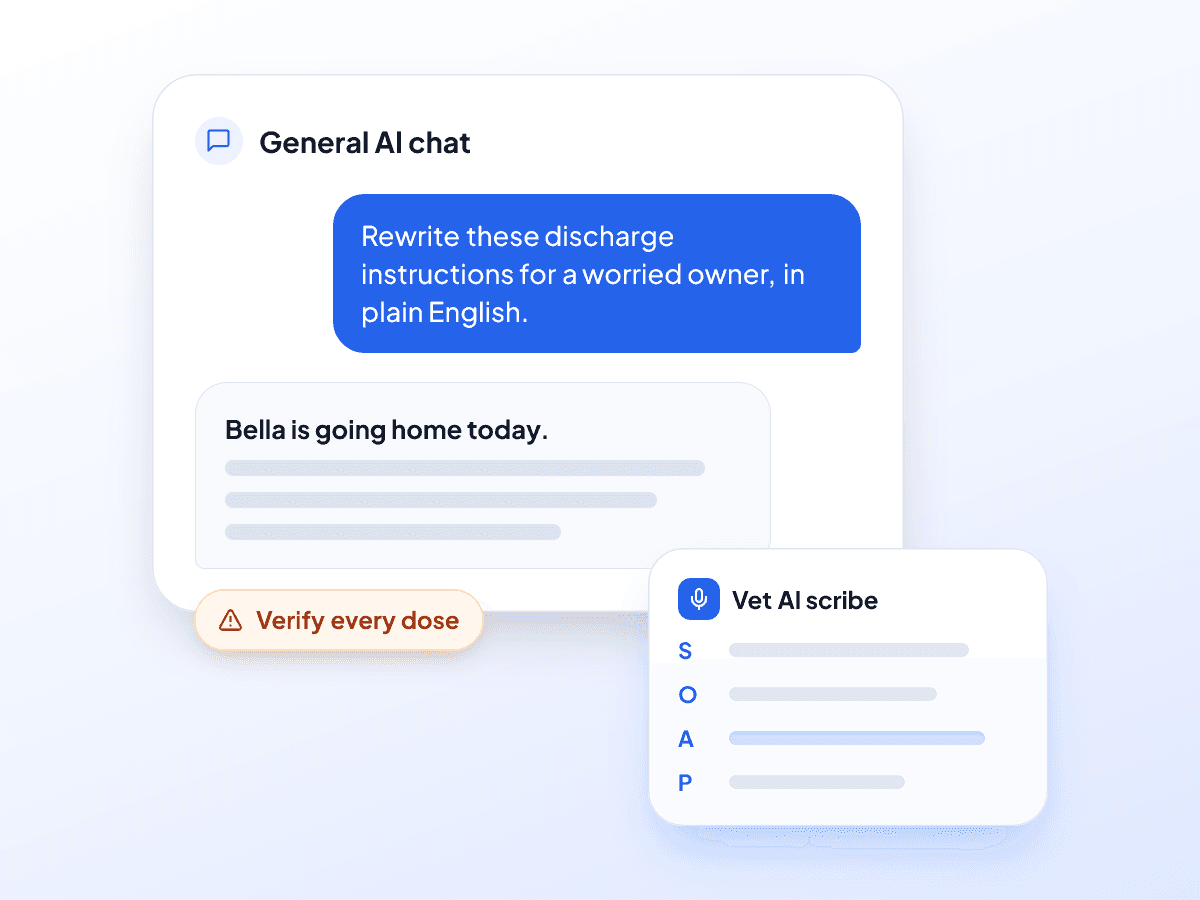
Paste your own discharge instructions (no client details) and ask for an owner-friendly version. Your clinical content stays the same; only the wording changes.
SOPs and checklists
First drafts of anesthesia checklists, opening and closing procedures, or a controlled-drug log routine. You correct the details; it saves you the blank page.
Hiring and team
Job ads for RVTs and CSRs, interview questions, onboarding plans and difficult-conversation scripts for managers.
Studying and CE
Have it quiz you, explain a concept three different ways, or turn your notes into flashcards. Check anything you will rely on against a textbook or the original paper.
Practice marketing
Seasonal social posts, newsletter drafts, website copy and review replies, written in your clinic’s voice if you give it a few examples.
Where it falls short
The limits that matter in clinical work
Drug doses and interactions
It can state a wrong dose with complete confidence, mix up mg and mg/kg, or miss a species-specific contraindication. Never take a dose from a chatbot. Use your formulary or a dedicated calculator, and check it.
Free drug dosage calculator →Citations that don’t exist
Ask for references and you may get papers with real-sounding authors, journals and years that were never published. Confirm every citation in PubMed or the journal itself before you repeat it.
Human medicine bleeding through
General models learn mostly from human-health text. Normal ranges, drug choices and phrasing can drift toward human medicine, and what is safe for a dog can be dangerous for a cat.
It doesn’t know your patient
It only knows what you type. It hasn’t examined the animal, can’t see the history in your PIMS and won’t tell you what it is missing unless you ask.
It can’t document your consult
To turn a visit into a record, it needs the whole conversation as text. Typing that out takes longer than writing the note, which is why vets use scribes that listen instead.
Recent changes
Its knowledge has a cut-off and it may not know about new approvals, label changes or recalls. For anything time-sensitive, go to the manufacturer or regulator.
Privacy
What not to paste into ChatGPT
HIPAA doesn’t cover animal health records, but confidentiality still does. Veterinary records are confidential under the AVMA Principles of Veterinary Medical Ethics and, in many states, under state law. Your clients also trust you with their names, addresses and payment details.
On consumer ChatGPT plans, conversations can be used to improve OpenAI’s models unless you turn that off in the data controls settings. Business plans handle data differently. Check OpenAI’s current terms for the plan you use, and agree a short practice policy so everyone follows the same rules.
Remove before pasting
- Client names, addresses, phone numbers and emails
- Payment or insurance details
- Microchip, account or record numbers
- Anything a client told you in confidence
- Staff personal information
Fine to paste
- Species, breed, age and weight
- Your de-identified clinical notes
- Your own handouts and SOPs
Copy and adapt
ChatGPT prompts for veterinarians
Explain a diagnosis to an owner
After the visit, by email or text
You are writing on behalf of a veterinary clinic. Write a short, kind email to a pet owner explaining that their [species, age] has been diagnosed with [condition]. Explain what it is, what we will do next ([plan]) and the signs that mean they should call us straight away. Keep it under 200 words, at a 6th-grade reading level. Do not add medical facts that aren't in this message.
Rewrite discharge instructions
Owner-friendly aftercare
Rewrite these discharge instructions so a worried owner can follow them at home. Keep every instruction, dose and time exactly as written. Use short numbered steps and a "Call us if" section at the end. [paste your instructions, with names and contact details removed]
Talk through an estimate
Before a cost conversation
Help me explain a treatment estimate of [amount] for [procedure] to a client who is worried about cost. Give me a short script that explains what the estimate covers, why each part matters, and two lower-cost options we could discuss: [options]. Warm, honest, no pressure.
Sympathy card after euthanasia
A personal note, not a template
Write a short handwritten-style sympathy note from our veterinary team to [owner first name] after the euthanasia of [pet name], a [species] who was with them for [years] years. One detail to include: [something you remember]. Sincere and simple, no clichés, under 80 words.
Draft an SOP
First draft for your team to correct
Draft a standard operating procedure for [task, e.g. "opening the clinic each morning"] in a [small animal / mixed] veterinary practice with [number] staff. Use numbered steps, list who is responsible for each, and mark any step that needs a veterinarian. I will review and correct it.
Write a job ad
RVT, CSR or associate vet
Write a job ad for a [role] at [clinic type] in [city]. What makes us different: [2–3 honest points]. Schedule: [details]. Pay range: [range]. Keep it under 250 words, specific rather than generic, and avoid phrases like "fast-paced environment".
Quiz me for an exam
NAVLE, VTNE or CE review
Quiz me on [topic] at the level of the [exam]. Ask one multiple-choice question at a time, wait for my answer, then explain why each option is right or wrong. After 10 questions, list the areas I should review.
Seasonal social post
Client education
Write three short social media posts for a veterinary clinic about [seasonal risk, e.g. "holiday food toxins for dogs"]. Friendly, practical, one clear tip each, under 60 words, no fear-mongering, and end with "Questions? Call us at [phone]".
Choosing the right tool
ChatGPT vs a veterinary AI scribe
Comparing scribes? See the best veterinary AI scribe software, or our broader guide to AI for veterinarians.
Put it together
A safe ChatGPT workflow for your clinic
- 1
Start from your own content
Paste your notes, handout or bullet points. Asking it to write from nothing is when it invents things.
- 2
Strip identifiers first
Remove client names, contact details and record numbers before anything leaves your PIMS.
- 3
Ask for wording, not facts
Tell it the audience, length and tone, and not to add medical information you didn’t give it.
- 4
Check before it goes out
Read every line. Doses, times and instructions must match your original exactly. You sign it, so you own it.
For toxin exposures, use a dedicated reference or an animal poison control service rather than a chatbot. Our free toxicity checker is a quick first look.
FAQ
ChatGPT for veterinarians: common questions
Yes, for writing and explaining: client emails, plain-language aftercare, SOPs, job ads, marketing and study. Treat it as a drafting assistant. Anything clinical, such as doses, diagnoses or references, has to be checked against a trusted source before you act on it, and the veterinarian stays responsible for the result.
HIPAA covers human health information, so it doesn’t apply to veterinary records. That doesn’t make pasting records into a chatbot fine: veterinary records are confidential under the AVMA Principles of Veterinary Medical Ethics and, in many states, under state law. Remove client names, contact details and anything else that identifies the client before you paste.
Don’t rely on it for doses. It can make arithmetic and unit mistakes and can miss species-specific contraindications while sounding certain. Use your formulary, a purpose-built dosage calculator, and your own check of the result.
It can reformat text you give it into S/O/A/P sections, but it can’t hear your consult. You would have to type out what happened first, which takes longer than writing the note. A veterinary AI scribe records the visit (or your dictation) and drafts the SOAP note for you to review.
Good prompts say who the reader is, how long the answer should be, the reading level and tone, and which facts to use. Add “Do not add medical facts that aren’t in this message” whenever the output goes to a client. The eight prompts on this page are a good starting set.
There are AI tools built specifically for veterinary work. AI scribes such as VetStack are the most widely used: they record the consult and produce a structured, species-aware SOAP note. Our comparison of veterinary AI scribes covers the main options and their prices.

Let ChatGPT write the emails. Let VetStack write the records.
Record the consult and get a species-aware SOAP note in under 60 seconds, ready to paste into your PIMS.
5 free notes a day · No credit card · iPhone, Android and desktop